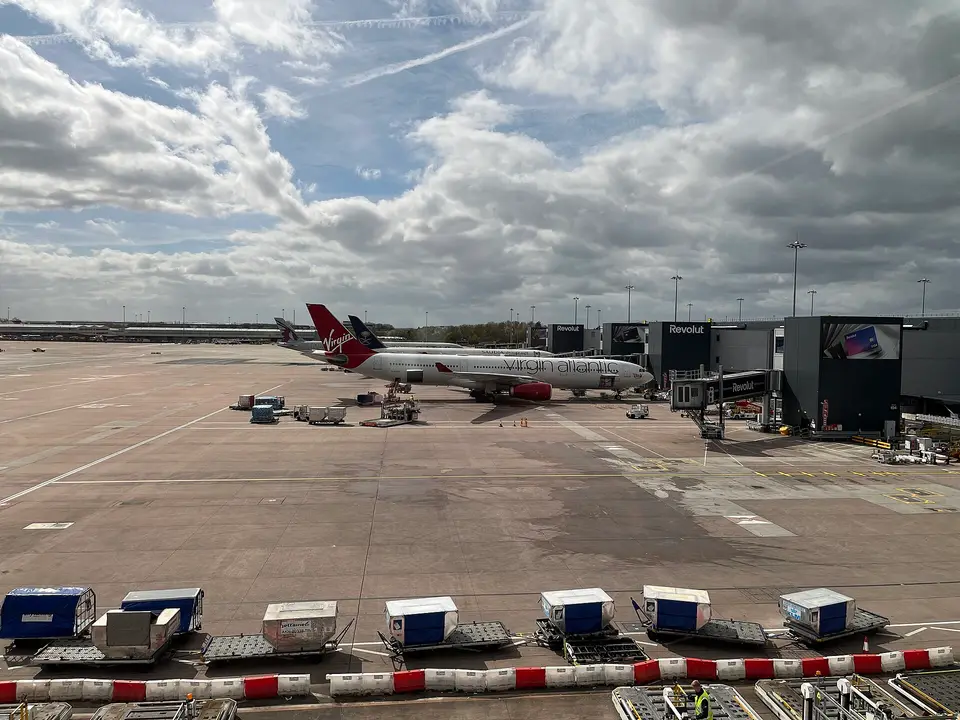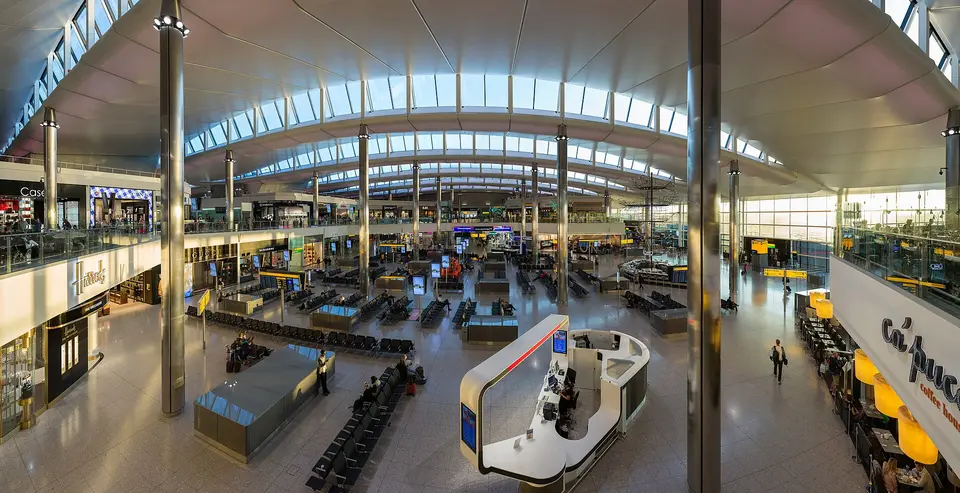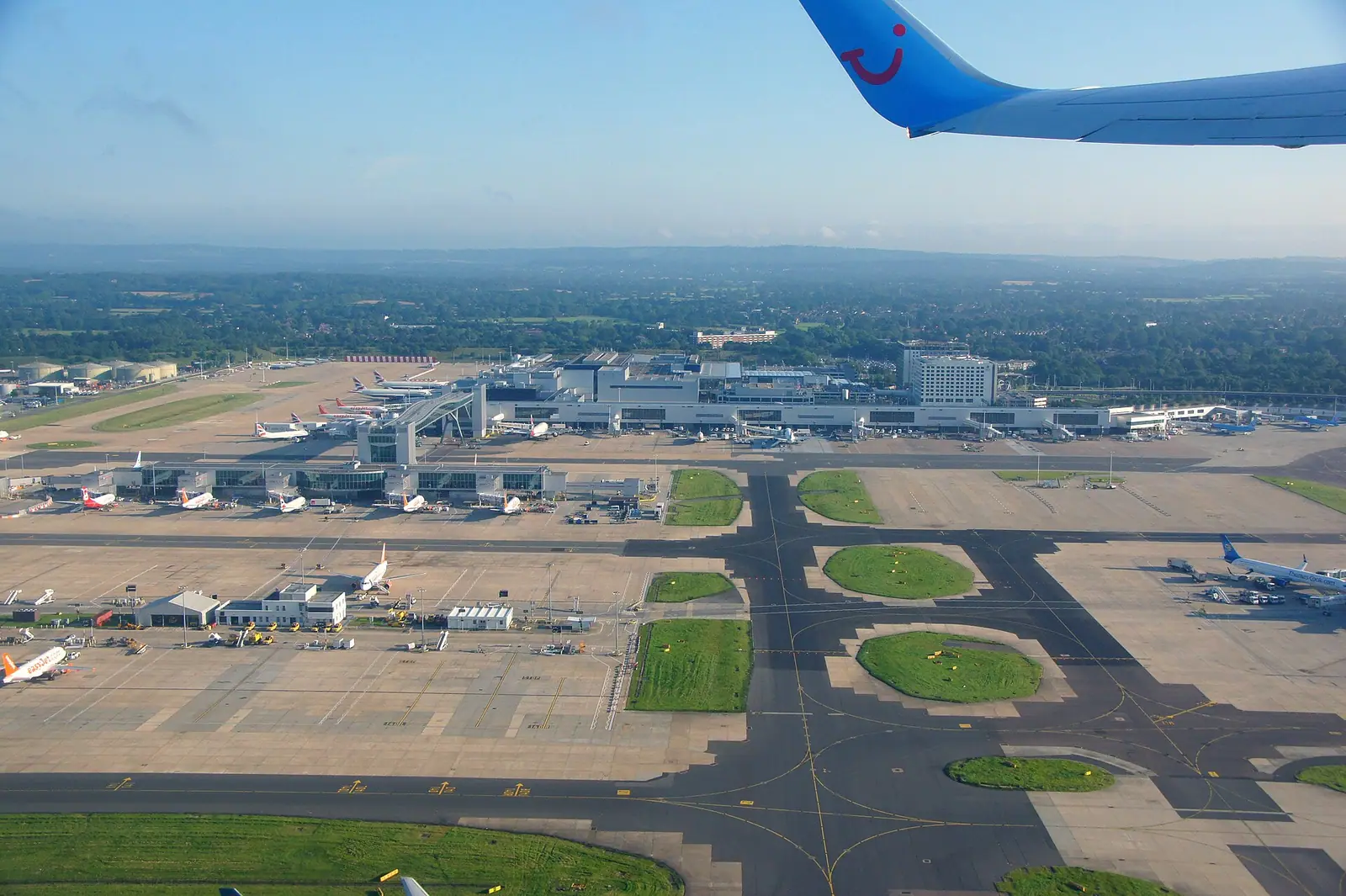
Gatwick is the UK’s second busiest airport, in West Sussex, about thirty miles south of central London. It is often described as the busiest single-runway airport in the world. Millions of people fly from it every year, many of them on holiday flights to Europe and beyond.
Unlike Heathrow, with its four terminals, Gatwick has just two: the North Terminal and the South Terminal. They are about a mile apart, linked by a free shuttle, and each has its own road, its own forecourt and its own car parks. Knowing which one you need before you set off saves a lot of trouble.
Airlines at Gatwick have moved between the terminals over the years, sometimes more than once, and some of the biggest airlines fly from both. Treat this as a guide and check your booking the day before. For London’s biggest airport, see our Heathrow terminals guide.
1. The South Terminal
The South Terminal is the older of the two, and it is where the railway station is. The modern airport was opened by the Queen in 1958, with a terminal that has grown into today’s South Terminal. It was one of the first airports in the world with a railway station built right into it.
Gatwick’s history goes back further than that. In the 1930s, the airfield had a circular terminal building known as the Beehive, which was linked to the railway by an underground passage. The Beehive still stands, close to the South Terminal, and it is now used as offices.
The South Terminal is a large building, with check-in on the upper level and a wide choice of shops, restaurants and bars airside. Its piers stretch out to the aircraft stands, and some gates are a long walk from security. Allow time to reach your gate, especially if you have children or heavy hand luggage.
The station sits right beside the terminal, a short walk from check-in. Trains run to London Victoria, London Bridge, St Pancras and Brighton, and to many other places. Passengers for the North Terminal arriving by train take the shuttle from here.
By road, the South Terminal has its own approach, signed from the airport spur road off the M23. It has its own forecourt for drop-off and its own short stay car park for pickups. If you are being driven, make sure the driver knows it is the South Terminal.
2. The North Terminal
The North Terminal was opened by the Queen in 1988, thirty years after she opened the original terminal. It was built as the airport grew, and it has been expanded several times since. It is a large, modern building with its own shops, restaurants and lounges.
The North Terminal has no station of its own, so passengers arriving by train take the shuttle from the South Terminal. The journey is quick and free, but allow a little extra time for it. Signs at the station point the way.
Like the South Terminal, the North Terminal has check-in on the upper level, security, and a large departure lounge with gates reached along piers. Some gates are a long walk, or a short ride, from the lounge. Watch the departure boards and head for your gate as soon as it is shown.
A large hotel is linked directly to the North Terminal by a covered walkway, and another is linked to the South Terminal in the same way. Staying the night before an early flight means you can walk to check-in. Other hotels nearby run shuttle buses.
By road, the North Terminal has its own approach too, signed separately from the same spur road. It has its own forecourt and car parks. Going to the wrong terminal by road is not a disaster, but it costs time, so tell your driver which one you need.
3. The shuttle between them
The two terminals are linked by a free shuttle, a small driverless train that runs on an elevated track between them. The journey takes only a couple of minutes, and the trains run every few minutes. It is one of the simplest parts of the airport to use.
The shuttle runs landside, which means before security. You use it if you arrive at the wrong terminal, if you come by train to the North Terminal, or if you are staying in a hotel at the other terminal. It is step-free, with room for luggage trolleys, pushchairs and wheelchairs.
From the windows, you can see the aircraft on their stands and the airport at work. Children often love the ride. It is a good way to pass a few minutes before a long flight.
If you are connecting between flights at Gatwick, the route depends on your airline and your terminals. Follow the signs for flight connections, and check with your airline how long you need. If you have to collect your bags and check in again, allow plenty of time.
The shuttle is very reliable, but occasionally it closes for maintenance, when a replacement bus runs instead. That can add a few minutes to your journey. On a busy morning, it is one more reason to leave a little spare time.
4. Which terminal is yours?
The simplest way to find your terminal is to look at your booking confirmation, or at your airline’s app. The terminal is usually shown with your flight details. The airport’s website also shows each flight and its terminal.
Some airlines use only one terminal at Gatwick, while others fly from both, with different flights leaving from different buildings. Two flights with the same airline, on the same day, may leave from different terminals. Always check the terminal for your particular flight.
Airlines sometimes move terminals, and a flight you booked months ago may have moved since. Check the day before you fly, and again on the morning of your flight. If your terminal has changed, tell your driver as soon as you can.
For arrivals, the terminal you land at is the one you need to be collected from. When you book a pickup, the flight number goes to the driver, so they know which arrival to meet and which terminal it uses. If your flight is delayed, they can see that too.
Getting to Gatwick
By rail, the Gatwick Express runs non-stop to London Victoria in about half an hour. Thameslink trains run through London Bridge, Farringdon and St Pancras, and on to places north of London, while Southern trains serve Victoria, Brighton and the south coast. There are also trains west towards Reading.
By road, Gatwick is reached from the M23, which leaves the M25 at junction 7. At junction 9 of the M23, a spur road leads to the airport, with separate signs for the North and South terminals. The M25 and the M23 are busy at peak times, especially on Friday afternoons and at the start of the school holidays.
Brighton is about half an hour to the south. See our Brighton and Hove guide and our UK airports guide. For advice on timings, see how early to get to the airport.
Drop-off and pickup
Gatwick charges for dropping off at the terminal forecourts. With a booked transfer, the driver handles it. For pickups, drivers usually meet passengers in the short stay car parks, and your journey page shows where.
If you would like your driver to meet you inside the arrivals hall, add Meet and Greet when you book. Deciding between parking and being driven? See airport parking or an airport transfer.
Gatwick is simpler than it looks: two terminals, one shuttle, one station. Check your terminal the day before, and let the driver take care of the approach roads.
Ride with ZeroLanes. A car booked ahead, at a price fixed before you confirm, with the driver and the car on your journey page before pickup. Book an airport transfer.